The illusion of learning the Arabic language due to randomness in teaching methods and learning
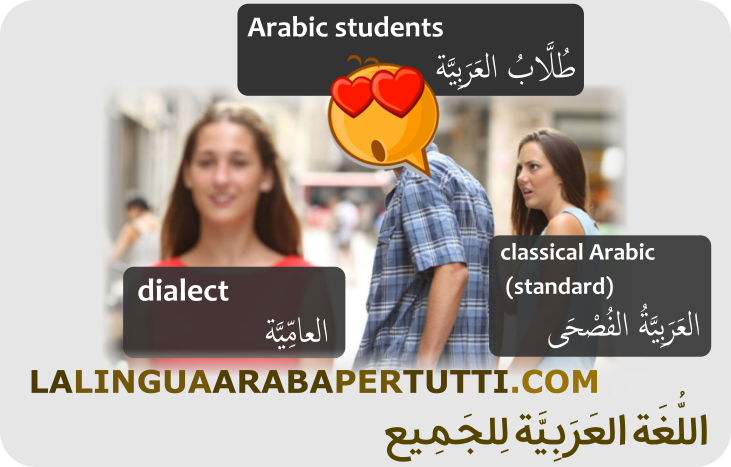
It is without doubts a gross picture, in fact I didn't want to use it at a first stage, but in the end I decided to use it (after modifying it) for two reasons: first, because when I saw the strong reactions of the Arabic-speaking students to this picture, what draw my attention was the fact that so many of them said that this is a real picture that truly represents what is happening to them. The second reason is that this picture convinced me of the importance to discuss a topic that I call "the illusion of learning the Arabic language" and I’ll discuss it through three points represented by the following questions:
- Why many foreign-language students run away from studying standard Arabic, that they already started studying, to learn one of the dialects?
- Will these students really benefit from having studied a dialect when it comes to hold a job interview for an Arab embassy, a translation office or for any other post?
- They have studied a dialect, running away from classical Arabic, but did they really learn it?
I will treat this topic through many detailed pages...
First point: many escape from fusha to learn a dialect because they feel frustrated and because they are not able to practice it with the Arabs, they say that talking to the Arabs in fusha is "impossible".
First of all we have to know that Arabs learn Modern Standard Arabic at school or in the mosques when they learn the Koran, and then they stay in touch with it by reading the news in the newspapers (in fusha), using official documents (in fusha), listening to the news and watching some TV programs (in fusha), moreover every week they listen to the Friday prayer sermon (in fusha) and also by reading some books and novels (in fusha). Even children (and sometimes adults) constantly hear it when they watch cartoons because most of them are in Modern Standard Arabic and even the information written on the food packages and other products in stores is written more or less at 80% in fusha. So Arabs, in one way or another, are in contact with Modern Standard Arabic, even if they rarely practice it in their everyday life. For this reason, it is not possible to say: Arabs do not know fusha, otherwise how could they understand the news, read the newspapers, understand the exams questions at school and university or understand the religious people in the mosque, fill in the job applications, use the documents and finally buy their favorite products?
It is possible to state: Arabs do not use fusha when they speak to each other. This is correct.
Ok, the foreigner runs away from fusha because Arabs don’t understand him and they don’t answer him when he tries to talk in fusha with them, but why does this happen?
When a stranger speaks in fusha with an Arab, what does it happen? Here we have to explain a couple of situations:
- Situation A: Arabs are not used to practice Modern Standard Arabic and use it in their daily life, so an Arab will be surprised by two things:
The first surprise: the presence of a stranger in front of him.
In fact, he looks at him like he was a strange creature ... "is this a human being? Or a creature from the space? Ah! It looks like a foreigner! From Europe or from America? But he's not like those we see in Hollywood movies ..."
The second surprise: the foreigner speaks fusha (the language of television, newspapers, religion and school books).
Arabs aren’t able to answer naturally at the beginning (especially the first two times) so they observe you (yes, you foreigner!) and they don’t know how to reply to you at a first place, and perhaps they will start to interact with you at your third try. So don’t judge an Arab from the first meeting. Some Arabs, when they understand what’s happening in front of them, they will try - in good faith - to use the highest level they know in fusha (the one they hear in a religious, literary or political contexts). Their language is difficult because they are used to hear it at high levels because they are Arabs, and therefore the language used by these people will be difficult for the poor student to understand.
- Situation B: in case your standard Arabic is good, remember that every Arab has a different level of standard Arabic, the level of young university students will be different from that of the greengrocer from whom you buy vegetables, that will still be different from the level of the landlord from which you rented the house, which differs also from the level of a taxi driver and so on. Not all of them will respond in the same way and with the same level. Moreover it is very likely that they will spontaneously use some words from their dialects being convinced to use Modern Standard Arabic words.
* Here we have to mention also the fact that some teachers use words and verbs from the dialect while they are teaching fusha or pronounce some words or verbs of the fusha in the same way in which they pronounce them in their dialect without warning the student. This shows the teacher's inability to distinguish between dialect and Modern Standard Arabic. The result is that his lessons are like a salad, but bad to eat.
- Situation C: This is the most common in my opinion:
The student can force Arabs to speak in fusha only if his level in Arabic is advanced, but advanced for real (and here I’m not speaking about the certificates that this student obtained from the schools where he studied before, because the system of teaching the Arabic language for foreigners, in my opinion, is characterized by "anarchy" - at least until now. This concerns not only almost all the universities in the world, but also Arabic schools for foreigners in Arab countries and even arab private teachers. And the certificates, no matter how many, do not show the real student’s knowledge of the language, and you will understand this at the end of this article). Foreigners who have learned Arabic in the proper way, force their Arab friends to talk to them in fusha, I saw it with my own eyes. For instance, when they used to go to the immigration office in the Arab countries they were visiting at that time to renew their visa, they were writing their visa application in Modern Standard Arabic and were talking to the employees in it. These students faced some difficulties (linked to the surprise that affects Arabs when a foreigner talks to them in Modern Standard Arabic, as we have already said before), but the students were able to complete their mission. My students, who reached the advanced level, did this during their visits to some Arab countries and they have told me what they were able to do and they were very proud of themselves.
However, if the student's level is not advanced for real, if it’s a fake advanced level, the student can’t force the Arabs to talk to him in fusha. Perhaps some of you don’t believe what you are reading here now and say that I’m exaggerating: how can you put into question the level of a student who has obtained all these certificates and studied Arabic all these years long!!?? I will give you an actual example:
Many students who visit different Arab countries to study Arabic go shopping and before leaving the country they go to buy souvenirs for their families. Some of them try to practice what they have learned in Modern Standard Arabic in the stores and start the conversation like this:
الطالب : صباح الخير
البائع : صباح النور
الطالب : أريد أن أشتري قميصًا ، هل عندك قمصان جيدة ؟
البائع : نعم تفضل يوجد كل شيء ، أهلا و سهلا
Up to this point the student can still make it, but then he will start thinking about how to ask these questions:
- Do you have short-sleeved shirts? Long sleeves?
- Which sizes and colors are available?
- Where can I measure this shirt? Where are the dressing rooms?
- It seems to me to be of poor quality, do you have one of excellent quality?
- I would like an Adidas branded shirt, but a fake brand, I don't want the original because it's expensive.
- Will you give me a discount?
- Can I see the suit (elegant dress) on the mannequin?
- Can I see the suit that is in the window?
By the way: a shop window in Arabic is neither a شباك nor a نافذة
- Now try to translate this sentence:
"A collection of more modern models has arrived today"
The shop assistant could tell you this sentence in Arabic and if you can translate this sentence from your native language into Arabic, it means that if you hear it you can also understand it. If the student is not able to translate this sentence, how can he understand the shop assistant?!
The result of this situation is: if the student has learned all the vocabulary and sentences related to the shopping lesson and has correctly learned the grammatical rules of fusha (writing and reading), and he is able to build correct sentences (I focus on the word "correct") then, he will be certainly able to conduct this conversation and therefore the shop assistant (or any Arab who will meet him) will be ashamed and will start thinking ... (mhm..This is a foreigner, and he speaks fusha, our language and the language of our Koran better than me). The shop assistant (or the Arab person in general) will be forced to remember the fusha he learned at school, red in the newspapers and used to understand the cartoons during his childhood ... etc.) And he will talk to you in fusha as much as possible and the next time he will feel more comfortable talking to you in Modern Standard Arabic.
* But:
What does it happen if the student doesn’t learn the shopping vocabulary? And he can’t build correct sentences in fusha? (you can find this out through your translation of the previous dialogue, have you translated it correctly?)
Answer:
Arabs will immediately get bored to talk with him in Modern Standard Arabic, because it’s very hard for them to remember the words in fusha and form a sentence while the stranger responds with broken sentences and in a poor language, full of errors and with an inappropriate vocabulary, so they will switch and talk to him immediately in English, and if they don’t speak English, then they will speak with him in their dialect (because it’s easier for them than fusha). And later they will start to convince him to learn their dialect (because it's easier for them than fusha). They do this, without having any information about the reason that pushes the student to learn fusha, and that is to be able to use it in a future job.
Here I gave you an example of a single situation, now imagine other examples of this stranger in a restaurant, the hospital, taxi, etc ...
- I'm not against learning a dialect, but I'm just explaining what usually happens.
* The student with the true advanced level is always proud of himself and his fusha, and if people talk to him in English or in a dialect he immediately replies: "Please talk to me only in Modern Standard Arabic, I don't understand the dialect (or English) "because he knows he can talk and discuss any topic, such as shopping, marriage, sport, health, television, etc. With grammatically correct sentences and with about eighty-ninety percent of the vocabulary related to these topics. You may even know more words than you think you know.
* If students flee from the literary Arabic to the dialect, it’s not because the Arabs don’t speak it, but it’s because many students don’t have an advanced level in Arabic for real, even if they think so. So even if the Arabs would talk with them for a long time they won't be able to really interact.
Important note: if a foreign student tries to make them understand what he wants from them with wrong sentences and using words close to the meaning but without using the appropriate words and uses gestures during the conversation to make people understand what he is talking about, this means that the student is still a beginner, his level shows that the teaching methods received by the student are improvised methods, because he speaks like immigrants who are not in their country (obviously I speak about people who didn’t learn the language), of course the native speakers understand them, but this doesn’t mean that they speak the language accurately.
And I hope that for you, students, it’s not enough the idea to make Arabs understand what you want and just be satisfied with that (regardless of the level of accuracy of your sentences and words). You pay money and spend a lot of time learning and getting certificates to speak the language correctly, and not to talk like immigrants.
Some students think that I’m exaggerating in what I’m saying, but to prove you what I’m saying, please allow me to test your level, dear readers, through two exams:
This is an exam related to the grammar rules in the Arabic language and to the ability to build accurate sentences. These sentences will be used by the student in future conversations. Their structure in English may seem a bit unusual but they have been edited like this to be closer to their structure in Arabic and to be able to examine the Arabic grammar you have studied until now. And this is the first step:
please translate the following sentences using all vowels:
- The two balconies of the two students of our teachers are not beautiful.
- I hate the big cars
- She will hit you (PF) because the price of the house has become more expensive these days.
- Our dictionaries are useful, but our pens are not useful because they are not writing in our exams.
- I hate your (PF) difficult exams
- My two male friends sit behind the two fat female students of your male teacher.
- I prepared lots of food for them, but their (PF) two male friends don’t eat at home.
- Our rooms will be sunny, but our sleeping room will never be a children’s room.
- Our female students are fat, but they will be thin after two years because their two meals are disgusting.
- I hate that your (SM) two male friends are fat.
- The Muslims of Cairo will speak with the two Italians of the Embassy in order to be able to host new people this year.
- Why will you (PM) not call us, when we are under the two trees of our park?
- They (PM) will finish their two books before finishing the work of two lazy people (noun) of our university.
………………
Write a 10-line paragraph talking about your daily routine (I'll help you with few sentences):
waking up - making coffee to drink it in the backyard - getting dressed to leave the house - meeting friends and asking them about today's lessons - asking them for their dictionary because you need them for the exam - taking the bus and paying the driver ... … Blah blah blah ……… .. in the evening: watching TV with the family - call your friend at school to ask him about his day and his new job ... blah blah blah ... and so on.
* Now: write again the same text but use other three subjects (You (s.m.), the two students (f) / you (pl.m.)
CHECK YOUR WRITING AND GRAMMAR (WITH THE RED PEN) and count how many mistakes you have committed.
Good luck!
………………………………………….
* If you haven’t passed this exam with correct answers at least at 85% it is useless to continue with the second exam, because it means that you are making fun of yourself.
* if the books or notebooks you are using do not contain information that helps you pass this exam, then this is a clear proof that your learning method is random.
- Conversation exam:
- Write (in your native language) dialogues between two or more people on different topics, use the vocabulary and the sentences you normally use to speak about these topics, you can write rich vocabulary conversations because they will be written in your native language.
To help you, here’s a list of possible topics: shopping, health, hospitals, sports, marriage, technology, smartphones, drugs, war, etc.
- Now translate the conversations from your native language into Arabic in writing.
- Take the red pen and correct the conversations word by word and find out your level in writing these dialogues, because after that you will use them to talk to people.
- If your sentences are correct, you can use them in your conversations in fusha, so your problem will be just to get the Arabs used to talking to you in fusha, even if this takes time.
- If your sentences are wrong, or if you can't write them, don't blame the Arabs, start with yourself because your level is low and you're not ready for conversation.
"Who writes well speaks well, this is a rule in all languages"
* Anyone who reads this article and has no intention of trying these tests after reading them or even trying them in the near future then should also stop blaming the Arabs and stop discussing the possibility of speaking in fusha with them because "you didn’t put yourself in the line". He should consider himself in the position of having been “rejected" in these exams until he proves the contrary, by passing the exams. Do the exam and discover your true level and if you pass the exam then discuss how much you want ... If you don't find anyone qualified to correct your exams, send them to us and we'll give you the result.
* I don't want to frustrate anyone; I just want students to think seriously about what their goal is. If you want to use fusha for jobs that require the knowledge of Modern Standard Arabic, then don't sacrifice its study to switch to a dialect only because of these frustrating conversation situations (many foreigners don't even realize what happens in these situations). And the biggest disaster is that students learn Arabic with improvised programs and methods instead of well-structured methods.
Notes for those who learn fusha:
* Many students tell me in the first lesson "I spent my whole life learning the Arabic grammar and for this reason I don't want to study it anymore, I want to make conversation". But unfortunately, when I ask the student to write a paragraph about his daily activities (like the paragraph in the previous exam), I find many mistakes in the written paragraph (given that the student knows how to write it!). The mistakes he does reveal the fact that the student didn’t understand how sentences are built, without considering other mistakes related to the use of inappropriate words. For this reason, I usually tell him that we have to study the grammar again but in a constructive way, so that the student will be able to use the grammar accurately in his sentences and then move on to conversation. Until you are not able to write accurately on such a simple topic, starting to make a conversation will be useless (because if the base is wrong then everything else can’t be correct).
Regarding the conversation: if you are not able to write on such a simple subject then the whole conversation you will be doing afterwards will be meaningless because if the base is wrong everything else can’t be correct.
* The vast majority of the students I meet (already graduated, who have learned Arabic for a few years and took, unfortunately, certificates to confirm it) who have contacted me with the wish to do conversation lessons don’t pass the placement test and need to start again from the Arabic grammar that they have already learned before, but this time in a proper way and at the same time in a dynamic way, by interacting. And it takes between 50 and 60 hours (don't be surprised, this is the simple truth) to be grammatically ready to face the conversation lessons on various topics. Most of my students who put comments on my website have already gone through this phase.
You can read them to understand how, later, they confirmed that what I'm telling you is true.
- Christoph S. (Germany)
- Daniele M. (Italy)
- Alessandra T. (Italy)
- Yasmina S. (France)
- Jonathan S. (UK)
- Yasmin A. (USA)
- Davide De B. (Italy)
- Brent E. (USA)
- Giorgia C. (Italy)
* Some Arabic students think that I focus too much on grammar and writing and that I neglect the listening and assimilation part, but this is not true at all, because I focus on grammatical rules and writing only in a first place and when they have a solid background they will be able to understand what they hear. The listening exercise comes later and is never overlooked.
- The grammar was killing me
- There is too much grammar
- I studied the Arabic language for five years and I'm ashamed to say that I can’t speak it even though I know the grammar well enough, etc.
* These are some of the sentences that students write or say about grammar. The first two sentences show the unsuitability of the method that these poor students use to study because usually you should study the grammar and finish it and the second step will be to apply it into the conversation. Grammar, as they say, kills them with its abundance. For this problem there are two possibilities: perhaps the teachers repeat it continuously and the students don’t understand its use. Here the mistake is in the teaching method and if it doesn’t change (and usually he is going to change it with a worse method or with the same level), the student will continue to run in circles with the grammar like a hamster in his wheel. Another reason could be that teachers focus on grammar for long periods because of their inability to give new topics. All the teachers use more or less the same books, they have different titles and shapes but all of them go hand in hand with the bad teaching methods, they have not been issued for foreigners. Most of these books are copied from Arabic-teaching books prepared for Arab students in elementary, middle and high school. Those books are not suitable for teaching foreigners even if on the cover they write "Arabic for foreigners", "Arabic language for non-native speakers". Unfortunately, they recommend these books to students and then you will notice that they are always looking for better books. So far none of the teachers is ready to write books that are really useful for this job.
A note about the third sentence: I suggest you to try the grammar exam, if you pass the exam, the problem is only that your teachers, after the grammar, didn't know how to give you new useful things for the conversation and this is their fault and not yours. But again, try to complete the grammar exam if you are sure that you have learned all the grammar in a good way and you don’t believe that there’s anarchy in the teaching methods you have received during your study of the grammar rules.
An extremely important note:
Reading texts in Arabic, understanding them and translating them is not a way to measure your knowledge of the Arabic language or any other language, because to do this is easy and everyone knows how to do it. You can deduce the meanings by linking them to verbs and words you've already studied. But the yardstick is the ability to create correct sentences and consequently to write correct texts with these sentences and know how to use them in the conversation and to be able to express what you think through the language you are learning. The real challenge will be to be able to translate what you think from your native language into the Arabic language. Translating Arabic texts using the dictionary, this is very far from being good.
2. Will these students really benefit from studying a dialect when it comes to face a job interview at one of the Arab embassies, a translation office or any other post?
After the students have spent years and years learning Arabic, fluctuating from fusha to dialect, usually they go back to their countries and try to work as translators, employees in an Arab embassy or even at the Ministry of Foreign Affairs of the their country. When it comes to undergo the exams, these are usually of two types: written and oral. The written exam is 100% fusha and the students are surprised for two reasons:
- Because they haven’t been used to write during their lessons and they only read from books and are not really able to write.
- Some of them have spent more time learning the different dialects of the countries they visited ... so the exam will be difficult for them and the result will disappoint their expectations.
- During the oral examination the student is required to use fusha properly but the examiners will close their eyes if the student speaks a dialect while they ask questions in fusha and will let him speak. If the student speaks fusha correctly 100% he will pass the exam, but if he speaks a grammatically incorrect fusha mixed with dialects (and usually with incorrect grammar or without grammar at all), then he will be rejected. Because the examiner certainly understood what you wanted to say, but the way you speak is the same of an "immigrant" and you will not be able to present yourself properly at work.
* I say as immigrants just to give an example and to give a clear image close to reality, far from any kind of racism.
Regarding the previous topic, about the job interview, I talked about it with some students who did the exams and were rejected, but before talking about it I examined their level and my answer for them was: how do you think to be able to pass such an important test, which requires a very advanced level of the language, and you are not able to write a paragraph of ten lines or speak for fifteen minutes on simple issues without any mistake?!! After examining their level, I asked them to repeat the questions that the examiners asked them, then I proposed them to pencil down the answers in writing and orally and after that I showed them their mistakes. How sad it was to see their faces after they realized that all they had done over the years was in vain! This is really a disaster!
To be more precise, perhaps those I met and to whom I explained the real situation realized that they have lost many years because of wrong teaching methods they used during their studies.
For other students, who don’t understand the real situation and remain skeptical: how does it happen? How could it be that I have studied all these years and failed to get a job? They find no answer and so they blame the Modern Standard Arabic, and they just consider it impossible to learn.
Below there’s a comment by one of the students who was not rejected in this difficult job tests and who, thank god, was finally able to reach her goal, but it required a very hard job.
(a student comment)
I’ve contacted Mohammad to prepare for the access exam to the Ministry of Foreign Affairs (France). It is a highly competitive exam that requires an advanced level in Standard Arabic, both written and oral. Until now I’ve not been able to find a serious teacher in Cairo who corrected students’ mistakes instead of letting them speak freely. Thanks to Mohammad, I learned how to write in Arabic clearly, with grammatically correct sentences and using idiomatic expressions. I even refined my vocabulary and improved my understanding of the Arab media.
In Arabic it is very difficult to improve your level when you have already an advanced level (the learning curve is slower), but thanks to the patience of Mohammad I took very high marks on the exam. For this reason, I strongly recommend his Standard Arabic lessons to all those students who want to improve their level and want to stop making all those mistakes that are usually not corrected by other teachers!
I also studied the Syrian dialect with him, and I must say that I was impressed by the quality of the teaching tools he uses: tables of verbs, transcriptions of Syrian soap operas, etc. I immediately improved my level. After studying for more than a year with him, my level, both in dialect and in fusha, went definitely to the roof and that’s why I recommend Mohammad.
“This year I passed the exam to become a diplomat … so I’m very happy. I wanted to thank you for all the work we did, I learned a lot with you.“
Forget all the talks about "Muhammad" and focus on the sentences:
"It is a highly competitive exam that requires an advanced level - Until now, I haven’t been able to find a serious teacher who corrected the mistakes of the students instead of letting them speak freely - I learned to write in Arabic clearly, with correct grammatical sentences - to all those students who want to improve their level and who want to stop making all those mistakes that are not usually corrected by teachers!"
... Exactly these sentences represent the dilemma.
* for this reason I would like to tell you to decide asap what your goal is and to concentrate on it until you reach it, even if the road is long. I advise you to try the exams I mentioned before and to face the problem right now, at a crucial moment, instead of destroying your dream that you have been waiting for years.
But back to our fundamental points:
- Did those who learned a dialect really learn it?
For all Arabic dialects the student needs between 25 and 30 lessons (50-60 hours) just to learn the grammar, even those who have already learned to write and read in Arabic still need to learn the grammatical rules of the dialect. Yes, all Arabic dialects have their own grammatical rules and if the student doesn’t learn the dialect grammar before starting to talk, then he will speak as an "immigrant" (as we have already explained for the fusha). Unfortunately Arabs usually don’t correct the mistakes of the student, even in the dialect, because they are interested only in understanding the idea of what they want to say and often the explanation on how to correct the mistake takes a long time and for this reason they don’t correct it. In addition, almost all Arabs don’t know how to explain the mistake and correct it in an academic and detailed manner, in fact, they always repeat that dialects don’t have grammatical rules.
* Some teachers, and perhaps most of them, don’t correct the mistakes for two reasons (I speak now about both the dialect and fusha):
- To avoid to destroy the student’s enthusiasm and to give him the feeling that he is progressing. This happens quite often, because like this the student continues the lessons and pays. This is the important thing for them: that the student enrolls in the next course and pays. And this is a scam from my point of view.
- others, on the other hand, know that explaining the error and correcting it takes away so much time, perhaps even the whole lesson, and therefore they don’t correct absolutely anything to the student. This is a trivial excuse.
Note: perhaps the dialect grammar is easier than the fusha grammar but the dialect is rich in grammatical rules, not always logical, which sometimes require only a memorization process, considering also the large number of exceptions.
Note: when I meet students who speak a dialect (Syrian, Egyptian, Lebanese, Yemenite, Iraqi, Gulf ... etc.), I immediately notice mistakes in grammar (in the rules for building sentences). "The dialect has rules but the Arabs are not aware of it unless they teach it or are forced to think about it. Usually they don’t do it, so you also discover that many Arabs repeat, out of ignorance, that the dialect doesn’t have rules , but when I hear a dialect different from mine, I immediately notice the student’s mistakes because the syntax of the sentence is illogical.
The problem that comes from "learning a dialect" becomes evident when students try to express themselves in one of these dialects. They believe that using them is easier, since the rules are relatively few, so they will end up using a language that will be a mix of dialects they have learned in addition to fusha (if they have learned it before) and they often speak with many mistakes (both in a dialect and in fusha), and the main catastrophe is that other people don’t correct their mistakes and leave them talk as they want because for them the important thing is just to understand what they mean and pretend not to hear the mistakes. This makes the students believe that they speak fluently and without mistakes and that they completely know how to speak one or the other dialect. This is only an illusion and it will be clear when they will try to watch Arabic TV series or listen to radio programs where they speak in dialect and they will only understand a small percentage of what they hear or when they will have to write down what they say orally, even if they try very hard, unfortunately the result will not be good.
And when foreigners meet a group of Arabs, who discuss about a topic, we usually see these foreigners (who say they know the dialect) taking only the role of listeners and when they will be able to participate only with simple or medium-level sentences, full of mistakes. And so their involvement will be equivalent to that of a child who wants to talk about important topics (sorry for this description, but I just want to make the situation clear).
An important note: we see that in the books to teach dialects, the amount of grammar is inadequate and is not reported in the index as grammar, and this is a serious mistake, studying dialect without grammar turns out to be a disaster.
Speaking in a dialect gives the student a dose of happiness due to the fact that he can practice it by using some sentences that have an immediate effect on people, but the student will always remain at a low level (or better said at the beginner level) and will never make any progress because his grammatical basis is very bad due to the fact that he never seriously learned the grammar.
An important note: one of the things that those who learn a dialect must know is that even in the high levels of the dialect we use the fusha, and it is quite evident: many words, many expressions, many sayings, many verbs and sometimes even whole sentences are in fusha because fusha is more expressive in some contexts such as politics, literature and current affairs.
A very important note:
Introducing yourself: name, where are you from? Your job, why do you study Arabic? In which Arab country did you travel? etc., this is a beginners conversation (the end of the first level) where you learn the grammar, you should know how to present yourself and for this reason the self-presentation is not a good parameter for measuring students' knowledge in Arabic (classic or colloquial). Moreover the students repeat this presentation over and over again whenever they meet a new person, and it is obvious that the presentation will be excellent and without mistakes since they repeat it all the time.
Note:
I see so many students giving advice on teachers and schools to their colleagues and I see written sentences like:
I got along well with him, he is very good and prepared
Or
I had a great time at this school, and the professors are well prepared and professional
I want to talk about these students’ tips:
There is a big difference between saying that learning with them has been really useful and has led you to improve and the fact that the atmosphere and environment of the school have helped you to become friends with the school staff and the teachers. The latter does not necessarily mean that you have learned well, even if you became your teacher’s friend and it doesn’t even mean that the school is excellent or that you have actually learned something.
There is a huge difference between your love for the environment in which you were feeling at ease while learning and the progress you made in that environment. Unfortunately it happened to me many times, during the first lesson with some students who learned Arabic before and took certificates, to hear at the beginning of the lesson:
My teacher was a professional, he was excellent, I was very lucky because I studied in that school, etc., but after taking the exam to define the level it turned out that they received a random teaching method and that for this reason we had to start all over again and sometimes I had to start from the letters - I really mean to learn to read and write again because of the catastrophic mistakes they made while writing. This happens with former Arabic students who say they have completed a level or two, and unfortunately there are many students like them.
Just to confirm what I'm telling you: whether you liked the school "as a place, for its atmosphere and as a community", or you loved it for what they did to improve your Arabic skills, please return to the previous exams and check the level of your knowledge (in fusha or in a dialect, the exam is valid for both).
Below I have a comment from one of my new students (from Italy) who has already learned Arabic with two teachers, a Syrian (native-speaker) and a non-native speaker (he learned Arabic and teaches it), and unfortunately, when she started with the first lesson I realized that she didn’t learn more than a few words and a miscellany of sentences, and when I saw her writing I was shocked, there were catastrophic errors, and among other things she couldn’t write properly the letters, unfortunately I had to start from scratch ... this is her comment after 5 lessons with me:
Comment by Chiara:
I met the teacher Mohammed Ghadi online. I was looking for an online Arabic teacher, I am a woman who works and I travel quite often, therefore an online teacher is the best solution for my needs. I choose Mohammad after a thorough investigation, I saw the content of the posts he was publishing on the social networks and particularly a video caught my attention, where one of Mohammad’s students, a non-arabist guy and not languages’ student was speaking in Arabic reading only some notes in Italian, this impressed me and I decided to make a trial lesson.
I very much enjoyed the trial lesson and since then I started to take lessons from the teacher Mohammad Ghadi. My previous experience during my studies in the Arabic language is made of different interactions and approaches. Before meeting Mohammad I used to think, naively, that I had reached a decent level in learning the Arabic language. I was able to translate complex sentences with different tenses, I had studied the grammatical cases, all rules to build the plural, the idhafa construction, Kana and his sisters and so on. Actually I was not able to read, I didn’t know the basic rules to have a good pronunciation and nobody ever taught me the difference between the three tipes of alif. I used to write incorrectly without paying attention to details and many other things that I have learned from teacher Ghadi.
In the past I attended some Arabic lessons from a mother tongue teacher – a Syrian woman – in the first lesson we learned the alphabet, in the second lesson the pronouns and after a while the verbs, etc…in my opinion this teaching method has been too fast and I couldn’t acquire the essential rules for a proper pronunciation of the words.
Mohammad taught me this rules in a very simple and clear way, without using these unpleasant grammatical descriptions that you can find in some books to learn Arabic (Tresso or Veccia Vaglieri).
What I like in Mohammad’s teaching method is his attention to details, because it is in these details that I noticed the huge quality difference between his method and the one used by other teachers.
In Italy, I attended an Arabic course held by an Italian teacher with a degree in foreign languages, a teacher with a very good profile. But, unfortunately, the method used by this teacher with lots of grammar and few practice did not allow me to experience the language.
I am very satisfied of teacher Mohammad’s method and even if I had to start again with the alphabet, I understood that I missed some important steps and I feel that this is a good chance to build my “little Arab house”.
……..
It is sad that I had to start with her again from the beginning and it is a sad thing for me to tell the student who has already studied, and has reached a certain level, that he has to repeat everything, but this time in a correct way, because the information he has received is vague and doesn’t allow him properly to put into action at a later stage what he has studied. So the student will immediately think about the money he has wasted and the effort he made already. But thanks God, many of them understand the situation. Like it was for this student, for example, it doesn't matter now who taught her before, the responsibility for failing to learn Arabic falls on both. The first teacher failed to teach the writing and reading and cheated her by making her think that she has learned everything correctly and the other didn’t notice all these mortal mistakes in writing and speaking and didn’t correct the disasters of the first teacher. And if he had never asked her to write during classes, of course this would have been an even bigger disaster. She took lessons from two teachers and they never helped her to improve...The matter of teaching Arabic to foreigners is really failing.
* I meet people like this student since a long time and this comment is just an example of a student who represents what students experience and suffer in the same situation and who don’t understand that they are victims of the illusion of learning the Arabic language.
This is a comment of another student (Alessio) who describes his experience;
I started studying Arabic about six years ago, after visiting the Palestinian camp of Shatila, during a trip to Beirut.
I decided to study this language to better understand the culture and the people of the Middle Eastern area, for which I have always had a strong interest and curiosity and not for work purposes.
I therefore did what all students who want to study a foreign language do, without going to university, and I enrolled in a language school near Barcelona, where I have lived for some years**.**
Arabic is a difficult and complex language but logical and with certain fundamental rules. It requires commitment, attention, effort, constancy, it is not a language that can be studied in a superficial way, during your spare time. But above all it requires a good teacher who is able to guide you in learning this language accurately and helps you understand how to study it and use it without mistakes and any fear.
Unfortunately - like other students - I had to struggle from the beginning, not only because of the difficulties related to this language, which is already complex, but also because of other people’s way of teaching it. For example, first they have told me that grammatical cases were important, but then in practice no one uses them and so I didn’t have to use them and I could put a sukun everywhere because it didn’t change much. Or the lie that the Alif corresponds to an A.
I especially went very quickly from building simple sentences about the things we see and do every day to talk about biotechnology, climate change and politics**, without being able to assimilate the correct use of the language, nor to write properly about the things we were talking about in class, nor of course have the vocabulary to do it.** I found myself doing exams (and passing them ...) without fully understand what I was reading and listening and talking about complex subjects without having the means to talk about it or write about it without fear as I do in English, Catalan and Spanish.
At first I thought it was my fault and that I was not studying enough. So I decided to go to study in an Arab country and I went to Egypt for a course, where, however, they only gave me lots of vocabulary lists and texts to read on difficult subjects but this never allowed me to work and overcome my difficulties. I therefore decided to go to Lebanon and take private lessons. Unfortunately, besides wanting to teach me at all costs the ammiya lubnania, the lessons consisted only in reading the texts of the Al-Kitaab, without ever working on my difficulties, mistakes and fears.
I essentially spent years studying in various schools dragging with me gaps, imperfections, mistakes, insecurities without being able to solve them. There is nothing worse than knowing a language without knowing the basics and to use it in a bad way or to believe to know it or more simply, not to know it at all.
I therefore decided to switch to the internet in search of a teacher who could help me. Thanks to modern technologies, there are indeed many offers and opportunities to study online. Unfortunately, even online it’s not easy to find a good teacher. It is not enough to be a native speaker to be able to teach. In fact, I found myself taking lessons with teachers who said to me "What do you want to do? (but sorry I'm the student, you are the professor !!). With some I had some not very poor systematic lessons, random, jumping here and there, without a logical thread and others I couldn’t even see them on the screen during the lesson. Result: more waste of time and money.
Then one day I came across the webpage of " La Lingua Araba per tutti = The Arabic Language for All" and I became intrigued by how the student was invited to try to write a paragraph about his daily routine, do some grammar exercises and translate weird sentences to verify the use of the dual and grammatical cases, to check the mistakes and to think about them.
I have therefore decided to contact Mohammed Ghudai and start the journey slowly again in this language.
We study the grammar step by step, conjugate verbs, he makes me use Arabic to talk about everyday things, build sentences and do exercises. He tries to make me overcome my fears by inviting me to write, he corrects my mistakes and, above all, he is the one who is teaching and he never asks me "what do you want to do?" randomly, without a logical thread.
He also showed me how often the students don’t realize how badly they learn the language and how, in the Arabic schools, they teach them some mistakes and the students are not aware of it and they assimilate them and they will have to deal with it.
______________ 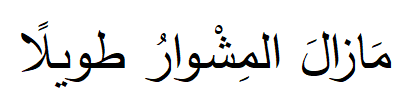
..... but I think I found a good teacher and that I’m on the right track
Guys don't waste time and money, try it!
.......
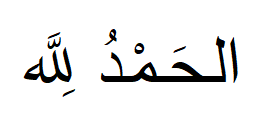
I was so glad to see his happy face while I was teaching him the grammar because he was finally able to understand it and use it practically in a conversation.
I will present here some important points to help you understand if the level of teaching that you have received or are currently receiving, is effective or totally confusing and random. (So: check the quality of your learning):
For beginners starting from scratch:
- Learning to read and write (in fusha or dialect) requires at least 8 full hours (480 minutes) before learning how to use verbs or words. 8 hours in the case of an excellent and diligent student who makes very few mistakes, God knows how long the slow or lazy student needs !! 8 hours full of explanations and exercises.
If you learn to read and write in less than 8 hours (even if you are excellent), it means that your learning will be absolutely fruitless, inadequate or random, and in the future you will undoubtedly have difficulties in writing, and as a result also in conversation. - The alif letter alone needs a whole hour in order to explain the different types and how we read it in all the positions within the word, and then in addition also the exercises.
* Many of those who have completed the first level or even the second (I have already met them) are not able to write and read the letter alif in the different positions of the word and are also not able to distinguish the ya from the alif maqsura, and this is a disaster.
Points for beginner, intermediate and advanced students:
3. If your teachers don’t give you homework at the end of each lesson and if they give you some but don’t correct it word by word in the next lesson and don’t ask you to focus on the mistakes in order not to repeat them later, then they have failed because homework is what shows the student's level of understanding of what he has learned and his ability to put it into practice. Ask them to make you write paragraphs or dialogues that you invent on your own in your mother tongue and then translate them and and ask the teachers also to correct them word by word and you will see the difference.
4. Many teachers focus on Arabic conversation during the lesson and many students believe that this is a good method. Some new students are asking me to have conversations in Arabic at each lesson for two full hours. We always hear from the teachers the phrase "don’t let your teacher speak your language, ask him to speak to you in Arabic." A pretentious sentence used to move students' feelings...nothing more than this, because the real problem is that there are important issues, including constant checks on the progresses of the student, which are neglected by these teachers:
- When a student is a beginner it is impossible to explain things to him in Arabic because he doesn’t know anything yet, the teacher needs a language to communicate and to make him understand the things he wants to explain to him. Even if some teachers reported that their students understood the meaning of words that had not been explained to them, this is a wrong conclusion, for example:
A new student who had already studied Arabic before, when she saw the expression سـلامـتـك مهمة (your salvation is important) asked me: why are they writing “your goodbye is important?” (she translated it wrong!!).
Her teacher, “the genius” ? explained only that in Arabic "maa assalama" مع السلامة is used to say goodbye to someone and did not explain the true meaning of the word salama, which means salvation (we speak of salama and not salam سلام which means peace) . And she deduced that this was the correct meaning in her mother tongue. Of course, at the first use in a different context of this word the student fell into an embarrassing mistake like this one. Being precise with students in the translation of words is important right from the beginning of the lessons. Honestly ... did you already know the literal meaning of "maa assalama" or is this the first time you hear it? If you knew it already it's a good thing, but if you didn't know it ... good morning to your teachers! ?
At the beginners’ higher level: speaking Arabic throughout the lesson, letting the student guess the words of his teacher and putting together the sentences to understand what he says is a process that will take a long time. And sometimes when the teacher asks at the end of the lesson "Did you understand?", The student will answer him by asking for the meanings of the fundamental words of the explanation and the whole explanation of the lesson depends on this and it turns out that the student did not understand the lesson at all. How can he understand it and ask for the meaning of the words used at the beginning of the lesson, in the middle of the lesson, etc.? And without these words he can’t understand in any way the core of the lesson, it is a waste of time and the teacher’s efforts become useless as well as those of the student.
I don’t think that the idea of speaking only Arabic during the lesson is good for the beginner and intermediate levels (this does not mean that it is an absurd idea and I will explain it in the next point) but if this happens, I would like the student to ask his teacher to correct all his answers, word by word, because what usually happens is the following:
The teacher speaks good Arabic, the student answers with mistakes in Arabic that the teacher doesn’t correct or corrects only a small part of it (the teacher usually corrects errors that don’t require a long explanation), and so the teacher and the student speak throughout the lesson and the student feels that his Arabic is excellent and continues to use it with the same mistakes. With repetition these mistakes get stronger, so 99% of my new students are shocked when I correct their mistakes that they've been using for years and they never corrected them before. Then I discovered that they spoke Arabic with their teachers and they were proud of it!!!
One day I was teaching a new student who didn't know how to tie the letters together correctly, I was surprised that he had studied Arabic for seven months in some famous schools for foreigners and with some private Arabic teachers as well. The collapse happened when I asked him:
- What did they teach you during that time? And he replied:
- We talked about everything.
- How about everything? Give me examples.
- We talked about my country, the Arab countries, tourism, time, sport ... etc.
- In Arabic?
- We spoke the whole lesson in Arabic and we barely used English to understand the meaning of some words, but the lessons were excellent, we talked a lot in Arabic, and I would like to make conversation in Arabic because I like conversation.
I was shocked and told him: we will study how to build a correct sentence in order to use it later in the conversation, your level is zero in building sentences, how did you talk about all these issues and you are not even able to build a simple accurate sentence??!!
I leave to your imagination how these lessons were.
- The teacher must speak in Arabic and let the student speak, but he or she must use a language appropriate to the level of the student and must always correct all the mistakes of the student, because letting the student speak without corrections means cheating him. If the student speaks for 10 minutes during the lesson and the teacher corrects his mistakes and then he uses the corrections in another dialogue in the next lesson, this is excellent. Speaking correctly for 10 minutes is better than talking an hour with errors and without being corrected. With time the amount of minutes will increase to a quarter of an hour, then half an hour, then an hour and so on. My students start with five minutes (correcting all their mistakes) and in the advanced level we also talk for two hours in Arabic...I hope the idea is clear.
A very important note:
If the teacher doesn’t correct the student's mistakes, this will lead him to not taking care of the fact that he is making mistakes. And this indifference won’t stop and will continue even in the advanced levels (advanced levels so to speak), but he will regret it, as we have already mentioned, at the first serious test he will have to face.
We will continue to examine the quality of teaching, but this time through general notes for all levels. Those are notes that warn you about the quality of learning and are for those who learn fusha, Arabic dialects, or both.
These are mistakes that some Arabic teachers make, look at them, take note and think about the level of your teachers in your school and the level of the authors of your books.
- For those studying fusha:
Who saw these verbs before?
إِسْـتَـخْـدَمَ إِسْـتَـعْـمَــلَ إِتَّـصَــلَ إِشْــتَــرَى إِهْـتَـمَّ إِبْتَـسَـمَ
These verbs, if written in this way (in the past as written here or in the imperative with different vowels) on your blackboard or in the teacher's videos on "YouTube" or in a book where you learned Arabic, means that those who taught you give lessons just because they are Arabs, but they are not qualified to teach. Writing the hamza under the alif in these verbs (past or imperative) is a fatal error, perhaps the student does not consider it a serious mistake, but for a teacher who should teach you it is an unforgivable mistake, because Arabs learn the rule of when you have to write the hamza or not at the elementary school, and when this mistake is made by an "Arabic teacher", this clearly indicates his ignorance.
- شَيْء (thing) this is the correct way to write it, any other way is not correct.
- يوم الإثْنَيْن (Monday) this is the correct writing, even if you don’t put youm first, some write it " الإثْنَان " if they don’t put youm before, but this is a mistake.
- The word identity is written هُوِيَّة and not هَوِيَّة because it comes from the word " هُوَ"
- We never put the hamza on the article, for this reason we never write أللغة ألعربية but only اللغة العربية.
On some books of English and American universities they put the hamza and continue to use it during all the levels. I didn't know exactly why, but I remember that I read in one of the books that they write it to make the student pronounce clearly the alif of the article (the explanation didn't convince me at all). The problem is that the student will be surprised when he will not find the hamza on the alif of the article in books, novels, newspapers, etc.
- When we see students who have learned Arabic (and unfortunately also some teachers sometimes) who write on social media platforms during Muslim holidays to congratulate them during the Eid the following sentences:
عيد الفطر مبارك يا أصدقائي / عيد الأضْـحَـى مبارك يا أصدقائي
Or for the Mother’s Day :
عيد الأم سعيد
And also non-native Arabic speaking Muslims, unfortunately, when they write, say or publish:
أتمنى لكم يوم الجمعة مبارك
This shows a clear problem of students' comprehension of the idhafa structure lesson. Therefore they always add the article "al" in the second word. Read the sentences below and start making the wishes is a correct manner. What was written above is 100% wrong.
عيدُ فطرٍ مبارك يا أصدقائي / عيدُ أضْـحَـى مبارك يا أصدقائي✔️
أو في عيد الأم : عيدُ أمٍّ سعيدٌ ✔️
في يوم الجمعة : أتمنى لكم يومَ جُـمْـعَـةٍ مباركًا ✔️
Some books and some teachers use the verb “shafa” " يَشُوفُ شَافَ instead of the verb “ra’a” ”يَرَى رَأَى” (see).
The fact is that some teachers flee from the use of the verb ra'a because it contains the alif maqsura and they think it’s too difficult for their students, especially when we have to attach the pronouns: you, them, you (dual), them (dual) , he, she ... etc
So they replace it with "shafa" and this is a serious mistake that indicates that the teachers are not interested in the students' improvement. If you try to find this verb in newspapers or TV programs that use classical Arabic, you will never find it. So they give you a verb that people understand because it exists in the dialect, but its use in standard Arabic does not exceed 1% and if some of these teachers have seen it, very rarely in a novel or in a poem, they must remember that "the poet has the poetic license" , it means that the poet and the writer has the right to use the words they like and transcend certain rules, but this is not a right that others have.
It is not possible for these teachers to consider this verb as a main verb and to deny the existence of the verb ra'a. It is better to teach students the verb ra'a (which they consider difficult) because teaching the student the conjugation of the verb will not take more than an hour and then using it in sentences to imprint it in the memory. The verb shafa is not used and is not common in the fusha and if your teacher denies this, then ask him five examples from books, newspapers and videos where they use 100% fusha. The verb shafa is a verb used only in the dialect and doesn’t have a concrete existence in the fusha.
2) To those who study fusha or dialect:
In the assessment test they need to correct everything you write and say, word by word, and present yourself, in this exam, shouldn’t represent more than 20% of the exam itself. Unfortunately some inexperienced teachers consider you as an Arab if you talk about yourself, without giving importance if what you are saying is true. As we have already said, the presentation is a topic repeated by the students every time they meet an Arab so for sure they master it, because they repeat it over and over again. Basing the student's assessment on the presentation of themselves leads to a wrong evaluation and the student will have a good mark without deserving it and maybe he will find himself later in a class at a level higher than his true level.
If your teacher writes the alif always only in one way, without the madda or the hamza, ask him to write the hamza when it’s meant to be and also the madda, because it is important for you to distinguish the words, especially when you read them.
For instance (an example from fusha) if he writes to you:
احب الفلافل أو سنتكلم عن هذا في يوم اخر
Ask him to put the hamza and madda where it needs to be written because it will become like this:
أحب الفلافل أو سنتكلم عن هذا في يوم آخر
The letter "alif" is different in the two cases.
- Learning Arabic (classical or colloquial) in Latin letters only helps you at the initial level. Those who learn Arabic (fusha or dialect) in this way will stop very soon and those who follow this path, to tell you the truth, are learning Arabic very badly and their examination will surely be very bad...I think it is one of the worst ways to learn it. The foreigner can learn Arabic in Latin letters in only one case: when he needs to learn it only for a short period, for instance: he will visit an Arab country for about a week or two, he needs some simple and quick sentences to manage his purchases, to move or ask for things, but we cannot actually say that he learned Arabic.
A tip: some schools and some teachers publish sayings and phrases taken by great writers on different social networks and write the translation of these sentences. Try to read these sentences and put vowels on it because this is a good exercise for you and you may find mistakes, you can correct them and then you can say that your progress will be real and you will be extremely proud of yourself.
3) To those who study Arabic dialects:
* when you study a dialect and your level is advanced, you will necessarily get involved with the fusha and you will find it in a large percentage of words and expressions.
Remember that when you reach an advanced level the fusha will be part of your lessons, in one way or another, because the level of your discussions will be higher. For this reason those who reach real advanced levels in fusha will discover that all Arabic dialects will be easier to learn. (The ones who learned it correctly and not randomly). But for those who learned only the dialect, dealing with fusha in the higher level will be difficult to manage and he will suffer more than the other student.
- Dear non-native student: when you learn the dialect of one of the Arab countries and then you go to live in another country, never think that the dialect you have learned in the old country can help you 100% in the new country, unfortunately, you have to learn the dialect of the new country to be able to interact with its people at 100%, but why?
"But you Arabs understand each other, even if your dialects are different"
I heard this sentence from some foreigners who moved to another Arab country, different from the country they used to live in, and were surprised by their inability to understand people clearly using the dialect of the previous country. What's the problem?
The situation is as follows:
When Arabs of different nationalities meet and talk about high-level issues and problems such as politics, literature, art and religion, these topics usually lead them to use the main words of classical Arabic because of the high level of the conversation, in which fusha inevitably intervenes, as we have mentioned before. And this is also true when it comes to simple and constantly repeated subjects, such as food and its types in every country, sweets, tourist sites, characteristics and atmosphere of each country. I thought that the Arabs could understand each other 100% thanks to TV series, media, Arab summits and the League of Arab States, but I realized through the experiences of Syrians refugees in many Arab countries, that they had to learn the dialect of the country where they are living. Some ask: but how? Aren't you all Arabs?
Yes, but communications problems come out when we talked about simple things related to our daily life, for example:
"Mine" (my thing):
| syrian | تَـبَـعِـي |
| egyptian | بِتَـاعِـي |
| Mahgreb | دْيـالي |
| Gulf countries: | حَقِّـي |
"cooking pot":
| syrian | طَـنْجَـرة (Tanjarah) |
| egyptian | حَـلَّـة ( "Hallah" . in syrian in means a big cooking pot) |
| nei paesi del Golfo: | قِــدْر (you pronounce it: jedr o ghedr) |
There are too many examples not to notice and understand the difficulty of those who have lived this experience. I have heard a lot about this issues from the Syrians themselves and about how many times there have been misunderstandings between the two speakers.
For this reason I say that, unfortunately, you have to learn the dialect of the country where you live to be able to work and do your everyday things, and the dialect of the previous country where you have already lived and the dialect you have already learned may be useful but not enough.
* This doesn’t deny what I wrote before, that whoever speaks fusha outstandingly, at a really advanced level, will be able to make it in the Arab countries and force the Arabs to talk to him in fusha.
4) Note on the suggestions of colleagues to learn Arabic:
Some foreigners (who have previously learned Arabic) made videos and uploaded them to their YouTube channels where they give advice on "How to learn Arabic easily" or "Learn Arabic in five steps" and many of those are very attractive. One day I discussed with some of them because I wanted to ensure their true knowledge of Arabic and I discovered that they are only good at:
- give random words and more or less long packed sentences;
- collect the words from the dictionaries and publish them as if they were a complete lesson, but they are not able to properly discuss for 10 minutes in Arabic (both in fusha or one of the dialects) and when I offered them to try to take the assessment test I showed you before, they didn't dare to do it.
Briefly: if a foreigner gives you advice on how to learn Arabic and talks like an expert, ask for his opinion on the assessment test (which I presented earlier) and try to understand if he did it or not, because if he didn’t or just pretends to do it, then it means that he’s not ready to give advice...don’t forget that there is the goal of profit under the attractive titles of their YouTube videos.
Miscellaneous on the same topic:
* Important note on the fusha for those who "learned it before": there are students who read a newspaper or a book or a sentence in Arabic and understand the syntax of the sentence, but they only lack on the understanding of new words. Their problem is the lack of an appropriate vocabulary to be used in various topics (I will call them students n° 1, for example), in my opinion their problem is normal and not serious. Other students read the same sentence and ask questions showing that they are unable to understand the syntax of the sentence and don’t understand the rules contained in it, and this is a disaster because this means that they are unable to create sentences (I will call them students n° 2).
I will give a clearer example, if I have a sentence like:
عندما يكون الحل صعبا نذهب إلى المفاوضات مع صانعي القرار
Students n.1 will ask: what is the meaning of the word المفاوضات (negotiations)? What does صانع (creator) mean? What is the meaning of قرار (decision)?
The number of words requested by students n° 1 seems to be large, but doesn’t show problems with their knowledge of the Arabic language, they are only new words.
Students n° 2, on the other hand, will ask:
- Why was the verb كان used at present? This verb is never used in the present form! ?
- صعب you should write it without alif !! Did you write it wrong, it's not alif !? ?
- What does صانعي mean? I answer: it is the plural of صانع (from يصنع)
- But if the plural is صانعون, why did you write it with ya? Then they discover: ah because there is the preposition ma'a, but why صانعي? Where is the nun? Shouldn't it be صانعين? ?
- They will also ask all the questions of the students n°1
The essence of the matter is:
The problem of the students n.1 are only the words, the problems of the students n.2 are:
- the use of the verb kana,
- the name of kana and the predicate of kana; I mean the practical application of the lesson on kana and her sisters and not just the study of the lesson itself. Perhaps they have been studying the lesson for years but don’t know the extensive practical use of this lesson.
- the lesson on the idhafa structure: the three questions show that the students n.2 have concrete problems in the grammar rules and need to rebuild all their Arabic grammar, taking into account its practical application, so once the teacher explained the lessons he should give many different examples...it's not just a problem, it's a disaster, especially because these lessons are part of the first level program. If you continue to learn Arabic without knowing it, it will be like driving a car without a steering wheel, one day you will have a bad accident, or the police will collect your license (the important thing is that one day you will be stopped!), and in our case the test is the exam to apply for a job.
- Some teachers ignore the existence of the dual as a formula and in the conjugation of the verb with: "their two" (masculine and feminine) "you two" (masculine and feminine), in classical Arabic. And they say that the dual doesn’t exist, and some book authors ignore it, or delay the teaching of the dual at a time that I consider illogical. The problem is that they insert lessons with grammatical rules more difficult than the dual one and unfortunately, as usual, without a complete explanation and without enough exercises to guarantee that the students assimilate them. Maybe this is due to ignorance or "cheating" with the excuse to facilitate the student’s learning process, I don't know! Will the dual destroy the student's career? Or as soon as he sees the dual he will abandon the study of the Arabic language??!!!
One day I was sitting in a bar and I was next to a foreigner who was sipping his coffee while reading the news on the elections in an Arab newspaper. I started talking to him and discovered that he had been learning Arabic for years (we spoke in English) and then when I saw the article he was reading I asked him:
Why is there no dual in your language? He replied: You don't use it either. And I told him: we use it sometimes in the dialect, but in fusha it exists and it’s always used. He laughed and said: No no, I never used it during my studies, even our teachers said it is not used, the Arabs don’t use it and they have never used it with us during our studies. I told him: what were you reading? He replied: this is an article on the elections. I told him: the article talks about the elections and there are two competing candidates, if you look at the article you will find that it will be full of duals and in fact I showed him words and verbs like:
مرشحانِ رئاسيَّان ِ - متنافسانِ - شاركا - يركزان في حملتيهما الاِنتخابيتَيْنِ على .... - مناصِروهما - أنصار المرشحَيْنِ - من حزبَيْنِ مختلفَيْ الإيديولوجيا ......إلخ .
I told him: haven't you noticed all this amount of duals in the article?
He seemed very embarrassed and incredulous for what he was seeing, and he too could not believe that he hadn’t noticed all the words and verbs in the dual form, because he is used to always ignore them, to understand only the general idea of the article.
I told him it wasn't his fault, but it was his teachers' fault, as well as the books and teaching methods he used and, of course, he was very shocked.
We must say that those who arrive at the level of reading the news in Arabic should remember that they are at a higher level and the fact that they are not aware of simpler things (such as the dual for example ... or the idhafa structure, the grammatical cases, the prepositions with verbs, conjugation of verbs) is considered a real scandal, and indicates that the whole study system was wrong and built on false basis. And don't be surprised if I tell you that there are so many people like this student, but most of them are not exposed to this embarrassing situation where the student is placed in front of the reality about his level.
* "I translate many articles from Al Jazeera, BBC, Sharq al-Awsat, etc. This is a good training to learn Arabic, and it's easy for me to do it. "
A sentence that we read and hear from many students. This suggests that it is possible to learn Arabic easily and that the student learns to translate, but let me ask you, dear student:
- Do you use the dictionary to translate the article?
- If the answer is no, that's fine and wait for the second question
- If yes, there is no problem so far, wait for the second question
- What percentage do you translate using the dictionary of this article?
- If the answer is between 40 and 30%, that's fine and wait for the third question
- If the answer is between 50% and over (60% 75% or more) it means that you are translating, but your vocabulary and learning background did not prepare you to read the newspaper, because reading the newspaper and understanding more than 50% using the dictionary is an easy thing to do for everyone ... Wait for the third question.
- Are you able to put vowels on all the words of the article (especially at the end of words)?
- If so, what is the percentage? If it is between 50% and over (60% 75%) this is good and then wait for the fourth question.
- If the answer is 40 or 30% or less, here is the problem, and as I said before: this means that your background did not prepare you to read the newspaper in classical Arabic at its highest level, where you have to know how to read the vowels. Now go to the fourth question.
- are you able to write a summary that is at least a third of the size of the article? Write in general the content of this article or explain your point of view on the topic of the article (using words, verbs and important expressions without copying the sentences word by word).
- If the answer is: no, then there is clearly a problem.
- If the answer is yes, then you are excellent in this language
I hope that those who can read the newspapers will decide to assess their level through these questions.
Very important note for those who learn Arabic fusha:
Reading the texts without the final vowels is certainly a way to make the language easier but deceives the student, because they have an incomplete competence and master of the grammar.
Grammatical cases don’t mean only vowels but also changes in the final letters. This is pretty much evident in the Arabic mass media and, even more, in cartoons in fusha. And how could we read the poems of Nizar Kabbani and Mahmood Darwish without vowels?!
Some teachers claim that the student's inability to progress is due to the "linguistic complexity of the Arabic language", and some say that it is necessary to study many years to be able to write a complete sentence!!! And they posted this photo as a joke!

How did the student Daniele and many others learn Arabic and reach high levels after 4 years via the internet and without ever having visited an Arab country? While so many foreigners have traveled to so many Arab countries, they have learned Arabic in so many schools and with so many Arab teachers and haven't reached the same level as Daniele and his colleagues?
Answer: due to the random teaching methods used by these schools and their teachers.
Daniele’s video (speaking in Arabic reading only some notes in Italian)
- Currently the phenomenon of "I am an Arab and I can teach Arabic (fusha or dialect) because it’s my mother tongue” has become widespread: these are Arabs who publish it on social networks, but the mistakes I discover in the posts and videos of these teachers show that they are not qualified to teach. It is possible that they are able to practice the language with foreigners (a practice where it is allowed to make mistakes), but they can only practice the language with them, because they are not able to build the language of the student in a constructive way, as teachers, not to mention the disorganized (random) teaching method they present to the student.
Just to prove what I’m saying, and that "many poor students do not realize they are victims of wrong teaching methods". This is a certificate obtained by a student in a prestigious school that students recommend to each other. He published it happy to have completed level 1 advanced. According to what he published on FB about the texts he studied in this school, he had to be able to find the mistakes in this certificate. He was very happy with the certificate and published the picture without noticing the mistakes in writing. The problem is that despite the number of likes for the picture of this certificate (more than 70 and most of them Arabic students like him) no one noticed the mistakes, not even his Arab friends (or maybe they just ignored them). Can you spot the errors or should I suggest them to you?

The word جذاذة is not commonly used in the Arab countries, usually they use the word شهادة, we use the word جذاذة, with the meaning of a small sheet for writing notes, but it is rarely used. This indicates that the professor is influenced by his own dialect, in which this word is used and that’s the reason why he used it, even if it’s not used in the fusha. The use of the word شهادة exceeds 97% in Arabic fusha, the word جذاذة instead is very rare or almost non-existent.
The word "الأعدد" ... what’s its meaning ??! They wrote it is wrong, it means nothing or maybe they meant "الأعداد" which means "numbers" and have forgotten the alif? But the question is: what does "جذاذة الأعداد الفردية" mean? The title of the certificate is not clear, even if we correct the word "الأعدد".
The correct version of الإنتاج الكتـابـيـي (the written test or the production) is الكتابيّ (with only one ya and with the shadda, this is a mistake for beginners).
The level: the correct version would be المتقدم الأول (the first advanced) and not
_الأول متقدم (the first is advanced)
_because the meaning changes without the article."المنسقة البيداغوجيَّة" (pedagogical coordinator), if an Arab person reads and doesn’t know Italian or French or another foreign language, then he will not understand it because here they are not using fusha. They could write: المنسقة التربوية أو المنسقة التعليمية, and this will be in fusha and everyone can understand it
And after all this there is the Arab professor's signature on the certificate (closing our eyes to the fact that his signature is in Latin letters) how is it possible that he didn't notice the mistakes on the certificate? Didn't he look at it? How can this student use it one day to go to look for a job in an embassy or in a translation office? They will read it and notice the mistakes immediately!!!
A note from the past: I still remember the moment when the director of the school (where I used to work in Syria) asked me to teach his student once. He didn't want to teach that day and he gave me the task, but I opposed him saying; "I don't know the level of your student and I don't know what program you are using with him, how can I suddenly enter and teach?" He replied, underestimating my speech: "go in and give him anything, the important thing is that the time of the lesson passes by”. I was shocked by this disregard for what the student learns, the important thing is that the student finishes the number of hours, that he pays and leaves for his country. I realized later that if this student would come back in the future they would find him any other program to let him spend the hours of his next course. And then I also realized that this is a policy used by so many schools, just to spend the time, no matter how, lessons taken randomly and without homework, cooking lessons, travel, music parties, etc. unfortunately without giving importance to the development of the real linguistic level of the student.
I am not against these activities, they are useful, but they must be accompanied by serious programs that build the language of the student. Unfortunately most of the times the student, after a few months in an Arab country, returns with pictures and videos of the tourist places he has visited and the dishes he ate there, but he will not be able to write few sentences correctly. This is a tragedy!
* An important note:
Some teachers and some students are totally convinced that there is nothing better than doing face-to-face lessons, but if your teacher’s program is not good and his teaching method is random (and the percentage of this kind of teachers is very high, higher than what you imagine), even if you are studying with him for 20 years you will not make any progress, not even one step. I do not say that distance learning (via Skype) is better than face to face, but your yardstick must be the teaching method and how serious this is.
And it doesn't matter if your teacher with you in person or is at the end of the universe, he is with you via the internet (with voice and image).
Unfortunately many teachers on the internet have ruined the reputation of distance lessons due to:
- Their random and very bad teaching methods (the subject of our first speech);
- These teachers do not care about the quality of the internet they use, because they use cheap and extremely bad internet networks.
- They have no respect for the lesson: one of my students told me that his previous teacher once taught him from the university cafeteria and another time he was in a restaurant and used the restaurant's wifi, which was very noisy, and the third time he was with his friends. The problem is that this teacher still tries to contact this student to find out why he abandoned his lessons (professional and useful).
Dear professor, you don’t respect the lesson and don’t respect the student and even the teaching profession.
A note about learning the Arabic language through the Arabic lessons channels on YouTube (classical or dialect):
Many Arabs make great efforts to put content that helps foreign students learn the Arabic language. They give free lessons on YouTube, so foreigners can learn the language from there. Unfortunately the lessons are usually standalone sessions and disconnected from each other and like this the student isn’t able to build his Arabic language in a real and gradual way. And it doesn't help him in making practical progress over time.
And most of the lessons are made for beginners: numbers, colors, weekdays, the verb in the present and the past (neglecting all types of verbs, their forms and prepositions related to these verbs and how to build sentences with these verbs and various meanings for the same verb in different contexts), and some simple dialogues, etc. And when they raise the level, the separation between one lesson and another increases and also their connection (they will be even more unrelated one to the other) not to mention the mistakes that are made by these teachers. Those mistakes make it clear that they teach Arabic only because they are Arabs and not because they are qualified teachers. Their mistakes prove the non-existence of the true practice of teaching, because when a professor teaches his students seriously and is in contact with them teaching them for long periods and facing an advanced level, then even the teacher will have an advanced level in teaching and he can build a solid experience by dealing with problems, common mistakes and even other matters that are hard to understand for students.
When the teacher faces a problem, he usually starts looking for a solution, but if we see teachers posting videos with clamorous mistakes (for those who know Arabic and not the poor students who are victims of these teachers), this means that their practical experience in teaching is non-existent, they post videos only. I have seen mistakes that can destroy your career as a "professor".
- There are also teachers who have both channels on YouTube and students in real life. But their students never go beyond the first level or the second (rarely), so the experience of these teachers, unfortunately, will always remain imprisoned in these two levels because they will not be able to bring their students to a higher level.
- All those whom I have met and who have already learned Arabic through these videos they have only learned many Arabic words and standalone sentences but they are not connected to each other. The student makes comments with a word or a sentence but is not able to make a whole and correct conversation that lasts for ten minutes, and concerning their writing skills the situation is even worse, I saw it with my own eyes .
- I mean: finding materials (many of these are of normal value or taken by chance) to publish to teach Arabic is a very simple process because you can find them in books and on websites. But those who have good and useful materials to teach Arabic to foreigners, good in the sense that they help the student to build a solid education: reading, writing and conversation skills (in dialect or classical) to reach high levels, believe me, will not put this program on the internet, they will keep it only for their students.
- There are many channels to teach Arabic, and they are multiplying quickly day by day, but we don’t see the results of these channels, we don’t see videos of students who have learned Arabic thanks to these channels and who have reached advanced levels or even intermediate. We see videos of many lessons and we don't see the fruits of it. I have rarely seen some videos of students who have learned Arabic using these channels but they are videos that do not exceed 2-3 minutes and their speaking level is never beyond beginners (fusha or dialect) and often the mistakes made by the students in these videos strip the teacher of his qualification (presumed) as a good teacher.
- Finally: also remember that the goal of many of these channels is to make money from YouTube with views, so you should not find it weird if your YouTube teacher makes mistakes because his concern is only to promote his channel and receive more money that comes to him thanks to the views of his videos, at any time.
They follow the "we teach anything" policy because no one among their poor students will be able to notice their mistakes.
* All the languages of the world are difficult but remember that the level of difficulty of the Arabic language, compared to other languages, is considered very high, not counting the different dialects that the student meets during his visits to the different Arab countries (together to the Arabs of different nationalities) and for this reason the Arabic language requires a very high concentration during its study.
* I don’t want to frustrate anyone, but I want to explain a situation where students can’t find an explanation, I know that what I wrote shocked many of you, but the doctor will tell you about your illness, no matter how serious it is and you will have to find a treatment before it becomes too severe, if possible. Reflect on the advice of this publication, many will read it and forget it a few minutes after reading it, the Arabs say:
"The advice costs a camel", which means that who asks for advice will give a camel to those who give him important advice for his life, as a reward. I don't ask you for a camel, but I just ask you to think about your situation after years of neglecting this advice.
Excuse me if I went into a long description and if I have repeated some points, but repetition is very important when it comes to talk about the various problems related to the teaching of the Arabic language and in general the causes of these problems are mostly similar.
Thank you very much to each of you who have read this article to the end and I wish you all success.
Mohammad Ghadi /